



MS Excel: How to use the ROUND Function (WS)
This Excel tutorial explains how to use the Excel ROUND function with syntax and examples.
Description
The Microsoft Excel ROUND function returns a number rounded to a specified number of digits.
The ROUND function is a built-in function in Excel that is categorized as a Math/Trig Function. It can be used as a worksheet function (WS) in Excel. As a worksheet function, the ROUND function can be entered as part of a formula in a cell of a worksheet.
Please read our ROUND function (VBA) page if you are looking for the VBA version of the ROUND function as it has a very different syntax.
Syntax
The syntax for the ROUND function in Microsoft Excel is:
ROUND( number, digits )
Parameters or Arguments
- number
- The number to round.
- digits
- The number of digits to round the number to.
Returns
The ROUND function returns a numeric value.
Applies To
- Excel for Office 365, Excel 2019, Excel 2016, Excel 2013, Excel 2011 for Mac, Excel 2010, Excel 2007, Excel 2003, Excel XP, Excel 2000
Type of Function
- Worksheet function (WS)
Example (as Worksheet Function)
Let's look at some Excel ROUND function examples and explore how to use the ROUND function as a worksheet function in Microsoft Excel:
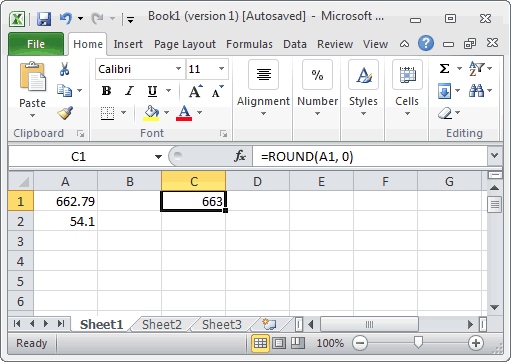
Based on the Excel spreadsheet above, the following ROUND examples would return:
=ROUND(A1, 0)
Result: 663

=ROUND(A1, 1)
Result: 662.8

=ROUND(A2, -1)
Result: 50

=ROUND(55.1, -1)
Result: 60

=ROUND(-23.67, 1)
Result: -23.7
Advertisements